Showing posts with label architecture. Show all posts

Friday, April 10, 2015

crossword


Thought behind the thought
Crosswords are fun! But at times, they really try your patience. Words just don't seem to agree with each other. They refuse to sit next to each other, or if they fit in, push others out of their way, leaving empty spots. But one just has to persevere. Finally, there comes a word that sets things right. And the whole puzzle just falls in place at once.
Just like life .....

About architecture and Design
Crossword lovers would surely like to see this happening in their neighbourhood!


With a large crossword puzzle installed on the side of the structure, this building in Ukraine has an address that no one can get wrong. Created as a part of a city-wide art installation, clues to the puzzle are scattered all throughout Lvov. You'll have to find them one by one if you're hoping to solve the giant crossword. Designed as a way to encourage people to visit the town's interesting locations, they're distributed among popular city landmarks, like theaters, monuments and museums.


How do you know if you got the answers right? You'll have to wait till nighttime, when the combination of the installed lighting system and the fluorescent paint fills up all the boxes with the correct answers. Measuring 100 feet in height, it is truly a sight to behold, especially when set against the backdrop of the evening skies.

Credit and source of information
http://www.coolthings.com/ukraine-building-gets-a-100-foot-crossword-puzzle-that-solves-itself/

Thursday, April 9, 2015

the lake


Thought behind the thought

Lakes are mysterious entities. Unlike a river, that flows and connects with people along the way, a lake seems to be content with herself, lying still at a place, engrossed in her own thoughts. People who come to her banks rarely ever see the secrets she hides at the bottom. Revealing nothing of herself is probably what the lake is successful at doing.The only thing they get a glimpse of, in the surface, which is merely a reflection of her surroundings!

About art and design

Lakes have been important as a source of water to human civilizations. More so in areas where rainfall is low, and water is a scarcity throughout the year. the western state of Rajasthan in India is one such dry and arid region that depends on stored water for sustenance. Artificial lakes built on the streams and rivers of Rajasthan are excellent examples of traditional rain water harvesting practices. 

What is more important is that a totally utilitarian concept has been made so beautiful by the people of Rajasthan!


Pushkar Sarovar is one of the oldest lakes in India. In fact, it is believed to be the starting point of Yuddhisthira's pilgrimmage in the Epic 'Mahabharat' A lot of inscriptions found at archaelogical sites prove Pushkar's existance since olden times (around 4th century B.C)
It is also one of the most important piligrimmage centres for Hindus, as the temple of the Creator Bramha is located here.


The town of Pushkar is picturesquely situated on the lake, with the hills on three side, the sands, drifted from the plains of Marawar, have formed a complete bar to the waters of the lake, which has no outlet, though the filtration through the sand hills id considerable.The form of lake is irregular elliptical. The lake is fed from the Nag Pahar. Bathing ghats have been constructed round the lake.


Pushkar Lake is surrounded by 52 bathing ghats (a series of steps leading to the lake), where pilgrims throng in large numbers to take a sacred bath, especially around Kartik Poornima (October–November) when the Pushkar Fair is held. A dip in the sacred lake is believed to cleanse sins and cure skin diseases. Over 500 Hindu temples are situated around the lake precincts. The ghats (steps leading to the lake) are not just utilitarian design elements, used for bathing and religious rituals, but an exercise in visual art, Architecture and Landscape design.


Like many other examples of regional architecture of the Indian sub continent, the Pushkar lake brings together people, culture, art and design seamlessly together in a vibrant built environment that respects and enhances  the environment that it is born and lives in! Something that we Indians must look at in this age of environmental crisis. It will be surely worth revisiting our roots and absorbing the wisdom of our ancestors from these relics of Indian design culture.


Credit and source of information
http://pushkarguide.com/pushkar-images-pictures/
http://en.wikipedia.org/wiki/Pushkar_Lake
https://www.facebook.com/pushkarguide/photos/

Tuesday, March 10, 2015

strength


Thought behind the thought
Strength is a quality that we believe is  inherent to all human beings. We think of it as our capacity to carry loads, to face difficult situations and come out unscathed from the experience. We also believe that the more we can bear, the stronger we are.
Is it really so? Or is strength the capacity to carry with elan, even the little load we may be required to carry? Is it the capacity to mould ourselves, to reinforce ourselves so that we can face any situation with equanimity? Is it about 'how' you carry, not 'what' or 'how much' load you carry?

Architecture and design
Paper is normally thought of as a 'weak' material when it comes to carrying great loads. Think again!


These amazing structures, made of paper (cardboard) tubes demonstrate the capacity of paper to carry loads and create interesting forms , in a way that is as innovative as it is elegant. Created by Japanese architect Shigeru Ban, these structures challenge the very notion of strength of a material. If paper can be used so innovatively, we can safely assume that given enough thought , any material could lend itself to the creation of amazing architecture.


Not only are these paper tubes used for creating long spans, but also for creating tall towers!


An architect by profession, Shigeru Ban has also been associated as a professor at several universities across the world, and has honorary doctorate degrees conferred on him. His list of awards is endless, topped by the Pritzker Architecture Prize 2014, one of the most prestigious awards in the Architectural field. Ban first began experimenting with constructing buildings from paper tubes in 1986, and he has continued to test new ideas of form and material ever since. For Ban, good architecture must answer questions of utility and sustainability even as it delights with aesthetics. 


"I believe that the material doesn’t need to be strong to be used to build a strong structure. The strength of the structure has nothing to do with strength of the material." Shigeru Ban


Credit and source of information
http://www.shigerubanarchitects.com/
http://aiare.org/quote-129-shigeru-ban/
http://en.wikipedia.org/wiki/Shigeru_Ban
http://blog.ted.com/buildings-made-from-cardboard-tubes-a-gallery-of-shigeru-ban-architecture/

Saturday, February 28, 2015

what and where i am


Thought behind the thought:

In India every evening at dusk, most homes will have a lamp lit in the household shrine. Light signifies enlightenment. It paves the way for knowledge and prosperity. It is a normal practice to chant evening prayers and sit in quiet, in complete solitude trying to be one with the creator. These quiet moments allow you to gather your thoughts, think about your actions through the day and mentally refresh you to take on challenges of tomorrow. All day you have questioned your existence and whether you have reached the place you wanted in life. In these quiet moments you realise that in the bigger picture, what you are and where you are, should be the same thing.

About the art:

What stands in our path towards personal growth are mostly we ourselves. Faith in a higher order or in a person or even in a cause helps us conquer ourselves. India is a land that abounds in places of worship belonging to a large number of religions. Jainism is one such religion that is an ancient and a prominent one in India. The Palitana temples located on the Shatrunjaya Hills by the city of Palitana in Bhavnagar district of Gujarat, India is a remarkable Jain temple city. Considered one of the holiest of all pilgrimage places by the Jain community, this temple-city was built as an abode for the divine; no one is allowed to stay overnight, including the priests. People of the Jain community believe that a once in a lifetime visit to this group of temples is essential as a chance to achieve nirvana or salvation. The meaning of Shatrunjaya is "place of victory against inner enemies" or "which conquers inner enemies.


The Palitana temples were built over a period of 900 years starting somewhere in the 11th century. They were destroyed by Turkish Muslims invaders in 1311 AD. The rebuilding began soon under Samara Shah. It was two centuries later that it picked up momentum in 1593 following which there was a major building activity here. What is remarkable about the temples is not just that they are incredibly crafted marvels in marble but the statistics of the complex is staggering as well.


There are hundreds of temples with estimates ranging between 863 and 1,008 present on the hill. Temples are arranged in systematic groupings with variation in height and space. They are grouped in nine separate wings or tuks, each wing having a separate central shrine or temple with minor shrines surrounding it. Many of the temples are very small buildings of only about 3 square feet in area (0.28 m2). These are decorated with Jain emblems, and sacred to Mahavira.


Amongst the larger temples are the Chaumukh temples, which were large halls used for holding discourses, are present. They are four sided buildings with doors located such that images would be visible from all four sides or directions. The four sided buildings are considered auspicious as they allow view from all directions. The religious texts of Jainism also suggest building "cities of temples" like Palitana and Ranakpur.


The architectural detail and intricacies of the temple are awe-inspiring. The marble floors have elaborate tessellated patterns. The interiors are intricately ornate, with carved ceilings of geometrical lace designs, clustered together to form a canopy. The entire cluster is a fabulous example of architecture of this style. Obviously highly skilled craftsmanship under the supervision of stringent patrons has resulted in this marvel. Legend goes that the sculptors' skills and capacity to carve intricate designs was paid on the basis of the marble dust that they had collected every evening after their hard labour. Maybe, in the modern world too one needs to introspect at the end of each day, “What is the dust that I have gathered today”?


Credits:


Monday, February 23, 2015

either / or


Thought behind the thought

Many a times, we stand at crossroads, staring at a seemingly difficult situation. Its either 'this' or 'that'! Tough choice. But it need not be so. So many things are seemingly complex, and if you think comprehensively from a totally different perspective, you discover that we could actually have the best of both worlds. We need not choose between 'this' and 'that'. We can have 'This' and also 'That', both at the same time!


Because things, situations, people, life ......  is always a composite of opposites, as most oriental cultures acknowledge. Be it the Yin-Yang of Chinese philosophy, or the Maya-Bramha of Hindu thought, the fusion of opposites to form a 'Whole' remains a dominant theme.

About The Art

Hindu philosophy is replete with examples of the fusion of two seemingly opposite concepts, the most well known of them being 'Ardha Narishwar' the half-male, half-female form of Lord Shiva.
http://www.britishmuseum.org/research


An early Kushan head of Ardhanarishvara, Mathura Museum

http://picasaweb.google.com/injamaven


http://www.shaktisadhana.org/images/Ardhanarishwaripage/adhanari.JPG

Ardhanarishvara (Sanskrit: अर्धनारीश्वर, Ardhanārīśvara), is a composite androgynous form of the Hindu god Shiva and his consort Parvati (also known as Devi, Shakti and Uma in this icon). Ardhanarishvara is depicted as half male and half female, split down the middle. The right half is usually the male Shiva, illustrating his traditional attributes.

The earliest Ardhanarishvara images are dated to the Kushan period, starting from the first century BC. Its iconography evolved and was perfected in the Gupta era. ThePuranas and various iconographic treatises write about the mythology and iconography of Ardhanarishvara. While Ardhanarishvara remains a popular iconographic form found in most Shiva temples throughout India, very few temples are dedicated to this deity.

Ardhanarishvara represents the synthesis of masculine and feminine energies of the universe (Purusha and Prakriti) and illustrates how Shakti, the female principle of God, is inseparable from (or the same as, according to some interpretations) Shiva, the male principle of God. The union of these principles is exalted as the root and womb of all creation. Another view is that Ardhanarishvara is a symbol of Shiva's all-pervasive nature.


relief in stone from elephanta caves, near Mumbai

relief in stone from gangaikonda cholapuram temple


view of the Ardha Narishwar temple, Velapur, Maharashtra, India, built around 1300 A.D
http://www.panoramio.com/photo/51200107

http://ardhanarinateshwar.blogspot.in/


Credits and Source of information:
http://en.wikipedia.org/wiki/Ardhanarishvara


Do also visit  http://youtu.be/nhmxRyMG3A8 for a mesmerising recital of the Ardha Nari nateshwar stotra by Pandit Jasraj.

Thursday, January 29, 2015

reach out


Thought behind the Thought

I am an avid sky watcher. Ever since I was a little child, I have been fascinated with the sky, the stars, and what lies beyond. Figuring out the patterns in the sky and trying to link it up in stories that I have read, imagining the celestial bodies moving about with their own forces and intentions is still a source of wonderment and joy to me.

And so it must have been, with our ancestors who gazed up at the skies. Almost all civilisations in the world developed their own astronomical theories and beliefs and tried to make sense of the world around, and of our position in the scheme of things.

And to finally reach out to the stars, both literally and figuratively!

Art, Design, Architecture


The 'Jantar Mantar', one of the most fascinating demonstrations of Indian astronomical study and construction, is a complex of built 'instruments' that measure heavenly phenomenon. Maharaja Jai Singh II of Jaipur, a patron of science and arts, constructed five such astronomical observatories between 1727 and 1834. Situated at Delhi, Ujjain, Varanasi, Mathura and Jaipur, these observatories are also fascinating visual art ... a striking combination of geometrical forms at large scale.
The grandest of these is the Jantar Mantar at Jaipur, and also the best preserved. Built in stone, a material that is perhaps as immortal as the science itself, the instruments are very accurately designed and crafted. Marble is used where the surfaces are clearly visible and great accuracy is also required. The observatory is still in use for both calculation and teaching purposes and still retains it's precision and accuracy. The various instruments are called 'Yantras' (Sanskrit word for instrument or machine)


Small Samrat Yantra
This is a sundial. It consists of a right-angled triangle, the hypotenuse of which is parallel to the earth's axis and which casts a shadow on one of the two quadrants below it. Each edge of the quadrants is marked in hours, minutes, and degrees. It gives the time to an accuracy of twenty seconds.


Large Samrat Yantra
An enormous sundial that towers majestically over the observatory. It operates on the same principles as its smaller counterpart, but it is ten times bigger and thus accurate to two, rather than twenty seconds. 


Dhruva Yantra
A brass instrument for finding the position of the Pole Star at night, it also serves to show the position of the twelve zodiac signs, each comprising 30 degrees of the celestial circle, and measures the declination of the sun 

Narivalya Yantra
A sundial with two masonry dials, one facing south and the other north. The former is used when the sun is in the Southern Hemisphere, from September 21 to March 21, and the latter when the sun is in the Northern Hemisphere, from March 21 to September 21. The central iron pinpoints to the pole. At noon the sun falls on the north-south line; before noon the shadow will lie to the west, and after noon to the east. The time is read in the normal way.


Large and Small Kranti Yantra
An astrolabe made of masonry and brass. One of the circles rotates in the plane of the equator, the other in the plane of ecliptic. It is used for the direct measurement of the longitude and latitude of the celestial bodies, and it can be used day or night.

Raj Yantra
"The king of instruments," this astrolabe is a map of the visible portions of the celestial sphere, which can be used to calculate a vast amount of astronomical data. A telescope is fixed to a rod that passes through the central hole. The back of the yantra is fitted with a bar used for sighting. The plain disk to the left is intended for use as a blackboard, to record observations and calculations as they are made.

Unnathamsa Yantra
A huge graduated brass circle used for finding the altitudes of celestial bodies. The circle can be revolved so that observations can be made at any time, day or night, and the sunken steps allow any part of the circle to be read.

Dakshina Yantra
A wall built aligned along the north-south meridian. The inscribed arcs on either face of the wall are made of marble and marked in degrees and minutes. It was used for observing the position and movement of heavenly bodies when passing over the meridian (an imaginary circle linking the poles that the sun crosses at midday).

Rashivalayas Yantra
Twelve sundials, one for each sign of the zodiac. Each instrument works in exactly the same way as the samrat yantras. The instruments have been so constructed that one is available at the instant each zodiacal sign crosses the meridian; hence they enable observations to be made approximately every two hours.

Jai Prakash Yantra
This elegant instrument acts as a double check on all the other instruments and is unique to the Jantar Mantar. The Jai Prakash measures the "rotation" of the sun. It consists of two hemispherical cavities set in the ground. They are complementary; if put together they would form one complete hemisphere, which would be a map of the heavens.
There is an underground passage connecting the two bowls. This is a fine example of Jai Singh's love of things that were both practical and aesthetically pleasing.


Large Ram Yantra
This and its smaller version have the same function. What the Jai Prakash does with a sunken hemisphere, the Ram Yantra does with an upright building. These two structures fit together to make one whole instrument. A sector in one building corresponds to a space in the other. The yantra is used to find the altitude and the azimuth of the sun. 

Chakra Yantra
A graduated brass circle that can be revolved about a diameter parallel to the earth's axis, this gives the ascension and declination – that is, angle of an object from the equator. 

Diganta Yantra
A simple and useful instrument to measure the azimuth, that is, the angle of any celestial body with the horizon. 

Friday, January 23, 2015

bridges


Thought behind the quote:

The past is a place we revisit all the time and it constantly lures us. Its steely grip prevents us from moving ahead in life .Burning bridges that lead to certain events, places and people can actually be an extremely liberating experience and hence it is a constructive and proactive activity. Building bridges can be as daunting an experience as burning them. The juncture where you choose to build a bridge can be full of challenge and may seem impossible. Again, what matters is where one is and what’s waiting for us on the other side. Most of the times we are building bridges that lead to places we don’t know anything about. Life has taught us one thing for certain, it is better to be moving towards the unknown than be stranded in one place and stagnating.


About the Art: 
The greatest thing about architecture and construction is the actual realization of a mere idea and making a reality out of a hypothetical possibility. Architecture and engineering marvels have shown us that anything can be achieved as long as you are ready to put in hard work and you have began with an original thought in which you have full conviction. Here are some architectural and engineering marvels that will leave us awestruck. Truly one can build a bridge anywhere anytime in their life provided the other side really beckons you.


Magdeburg Water Bridge is 918 m long, 34 m wide & 4.25 m deep but it is not a regular bridge. It’s a water bridge across and above the river forming a water intersection. This bridge is the biggest water crossing in Europe where you have boats sailing under and on the bridge as well. 


Millau Viaduct, France is a staggering 2,460 m long, 32 m wide & 343 m high, obviously a construction feat. It is the world’s tallest vehicular bridge.

The Jadukata Bridge, India is the longest span cantilever bridge in India with a central span of 140 m. It stretches so naturally from one shore to the other that it seems to grow out of and belongs to the surrounding landscape.

Sutong Bridge, in China is a cable-stayed bridge with the world’s longest main span of 1,088 m. Its overall length is 8,206 m and the two bridge towers are the world’s second tallest at 306 m. 


Akashi Bridge, Japan is a 6-lane highway and the world’s longest suspension bridge spanning 3911 m.


 Credits:


http://goldsea.com/803/06p-bridge.html


http://scribol.com/art-and-design/8-amazing-bridges-from-around-the-world/3


Tuesday, January 13, 2015

simply complex


Thought behind the thought
'Complexity' is a word we seem to have grown wary of. We are all the time looking to 'simplify' things, all based on our belief that simple is beautiful. It is, indeed. No doubt about that! A Haiku says a lot in three lines. Great 'modern' art and architecture is minimalistic too. In fact, the aesthetic sensitivity of the modern world has moved towards 'minimalism' in every respect. Simple lines, simple forms, limited colour palettes, monochrome, even black and white, for that matter! Modern Indian women shun adornment, except for traditional functions or festivals.Anything more than a stark silhouette and minimum embellishment is ' bling'.

Is that really what the typical Indian aesthetic preference is like? Aren't we a society that likes 'complexity' and 'plularism' in design? All our traditional art forms have subscribed to 'maximalism' Be it clothes, jewelry, architecture, painting, sculpture, or language. Ornamentation is an important part of the Indian aesthetic. Trained in the 'Western' aesthetic value system, Indian designers today have come to believe that simplicity and 'minimalism' are the same thing!

Not true, actually. Something minimal, may not necessarily be good. It can be perfectly ordinary, if not designed sensitively. On the other hand, everything that is complex need not be far from'good'. There is a great beauty to be found in the most complex of designs. Our Embroidery, jewelry, rangoli stand testimony to the simple beauty that shines through the complexity of design. The seemingly complex, is at times, simply beautiful!

Art, Craft and Design
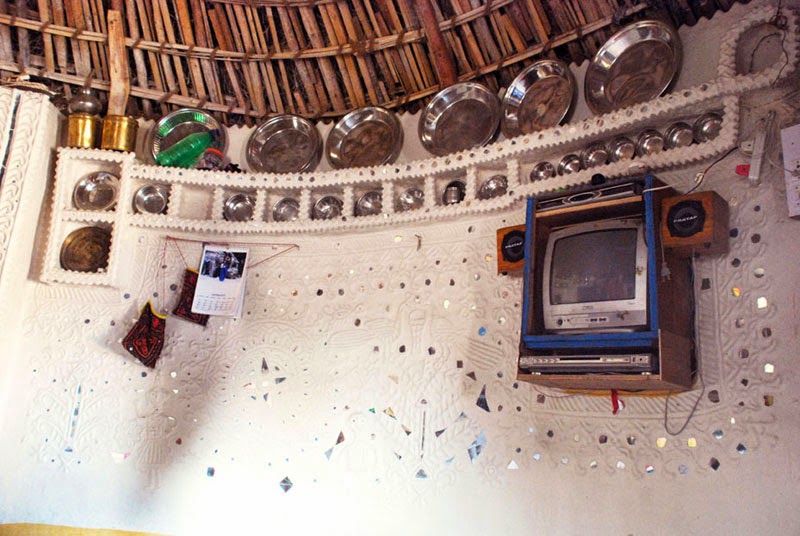
Like these 'Bhungas' or traditional houses of Kutch, Gujarat.Simple in concept and execution, they display great complexity in their 'decoration'. The interior space of the circular mud houses is beautifully decorated with mud plaster and mirror work that covers almost every inch of the space. The built in storage and furniture all come together under an elaborate surface treatment, as simple as it is complex!


These bhungas have withstood the extremes of climates, and the seismic forces in the arid deserts of kutch, keeping the inhabitants comfortable and safe for centuries.


 Everything about the `bhungas' is an art. Their outer walls are painted with mud colour motifs by women of the house every year during Diwali and exquisitely carved wood line the inner walls inlaid with mirrors.


 Their circular design and the steely mesh of mud plaster and twigs make them resist any wind pressure and quake. The `bhungas', which ``even a king would envy'' for its elaborate design and artistic elegance, have a light dome- shaped bamboo and thatched roof and a circular wall plastered with mud, twigs and dung.
Their thick walls keep the interior cool when the temperature rises to 46 degrees celsius in summer and warm when it drops to two degrees in winter.


Watch the video, to see how this seemingly complex  art is produced with simple materials by simple people!


Credits and source of information
'Bhunga': Kutch's engineering wonder
http://www.thehindu.com/2001/02/26/stories/0226000g.htm
Habitats of Kutch – Bhunga Documented by Professor Nina Sabnani, Industrial Design Centre (IDC), IIT Bombay,
http://www.dsource.in/gallery/gallery-0590/index.html