
Showing posts with label #designjatra. Show all posts
Showing posts with label #designjatra. Show all posts
Thursday, April 2, 2015

Tuesday, March 31, 2015
pool

Thought behind the thought
We have all been through this! When we first learn how to swim, and till we gather the courage to venture anywhere beyond 5 feet deep, we find comfort and safety at the shallow end of the pool. Here, we can try to float our body for a while, but safely touch our feet to the ground, if we can't! The confidence that comes with the knowledge that you are not going to drown shows in the way we splash with abandon there.
But eventually, we do take the plunge, reinforce our confidence and make a serious attempt to overcome our fears our drowning. Once we befriend the water and stretch our capacities, the deep end does not seem that far or deep enough. It is at the deep end then, that we surface with grace, humbled by the enormity of the challenge that we took up and met!
About design
Swimming pools are not just places where we could have fun swimming, they are also fun to design! And it shows, in all these images of amazing pools around the world.


The design of swimming pools also requires amazing technology to support it. Whether it is a temperature controlled pool atop a structure or underground , it is a feat of technology as much as it is a feat of imaginative design! Swimming pool design is therefore as much science as it is art, a challenging creative exercise!
Credit and Source of information
http://www.popularmechanics.com/technology/design/g594/worlds-18-strangest-pools/?

Monday, March 30, 2015

Saturday, March 28, 2015

Saturday, February 28, 2015
what and where i am

Thought behind the thought:
In India every evening at dusk, most homes will have a lamp lit in the household shrine. Light signifies enlightenment. It paves the way for knowledge and prosperity. It is a normal practice to chant evening prayers and sit in quiet, in complete solitude trying to be one with the creator. These quiet moments allow you to gather your thoughts, think about your actions through the day and mentally refresh you to take on challenges of tomorrow. All day you have questioned your existence and whether you have reached the place you wanted in life. In these quiet moments you realise that in the bigger picture, what you are and where you are, should be the same thing.
About the art:
What stands in our path towards personal growth are mostly we ourselves. Faith in a higher order or in a person or even in a cause helps us conquer ourselves. India is a land that abounds in places of worship belonging to a large number of religions. Jainism is one such religion that is an ancient and a prominent one in India. The Palitana temples located on the Shatrunjaya Hills by the city of Palitana in Bhavnagar district of Gujarat, India is a remarkable Jain temple city. Considered one of the holiest of all pilgrimage places by the Jain community, this temple-city was built as an abode for the divine; no one is allowed to stay overnight, including the priests. People of the Jain community believe that a once in a lifetime visit to this group of temples is essential as a chance to achieve nirvana or salvation. The meaning of Shatrunjaya is "place of victory against inner enemies" or "which conquers inner enemies.

The Palitana temples were built over a period of 900 years starting somewhere in the 11th century. They were destroyed by Turkish Muslims invaders in 1311 AD. The rebuilding began soon under Samara Shah. It was two centuries later that it picked up momentum in 1593 following which there was a major building activity here. What is remarkable about the temples is not just that they are incredibly crafted marvels in marble but the statistics of the complex is staggering as well.

There are hundreds of temples with estimates ranging between 863 and 1,008 present on the hill. Temples are arranged in systematic groupings with variation in height and space. They are grouped in nine separate wings or tuks, each wing having a separate central shrine or temple with minor shrines surrounding it. Many of the temples are very small buildings of only about 3 square feet in area (0.28 m2). These are decorated with Jain emblems, and sacred to Mahavira.


Amongst the larger temples are the Chaumukh temples, which were large halls used for holding discourses, are present. They are four sided buildings with doors located such that images would be visible from all four sides or directions. The four sided buildings are considered auspicious as they allow view from all directions. The religious texts of Jainism also suggest building "cities of temples" like Palitana and Ranakpur.

The architectural detail and intricacies of the temple are awe-inspiring. The marble floors have elaborate tessellated patterns. The interiors are intricately ornate, with carved ceilings of geometrical lace designs, clustered together to form a canopy. The entire cluster is a fabulous example of architecture of this style. Obviously highly skilled craftsmanship under the supervision of stringent patrons has resulted in this marvel. Legend goes that the sculptors' skills and capacity to carve intricate designs was paid on the basis of the marble dust that they had collected every evening after their hard labour. Maybe, in the modern world too one needs to introspect at the end of each day, “What is the dust that I have gathered today”?
Credits:
Sunday, February 22, 2015
jump

Thought behind the thought:
We are assuming too many things all the time. That too from only one standpoint, namely ours. We unnecessarily jump to conclusions and draw baseless inferences causing us more harm than anyone else. Martial arts are forms of dynamic art that teach us patience, forbearance and disallows being offensive. It teaches us to strike only when provoked. The single most important thing it teaches us is to always focus and concentrate on what important. It makes you circumnavigate a problem before attacking it and in this way one gets less harmed or hurt in the process.
About the art:
Kalaripayattu is an Indian martial art which originated in the state of Kerala. It is considered to be the oldest fighting system in existence this martial art technique is taught in the payattu kalari, meaning fight school. Kalaripayattu includes strikes, kicks, grappling, preset forms, weaponry and healing methods. Different exercises in Kalaripayattu are as follows:


Meipayattu means body exercises. It is a series of 18 different lessons designed to achieve peak physical fitness and flexibility of the body. They include specific exercise for legs, hips, hands and the torso areas in the body.
Marichilukal means Acrobatics. The acrobatic moves ensure that the body is fit, it’s a regular and good exercise regimen, helps in building and improving concentration and focus, and imparts confidence to the student. It also tones the body, makes it agile and improves reflexes.
Kaikuththippayattu means exercises with hands on the floor. Kaikuthipayatttu strengthens the body and conditions the student for proper breathing control. Breathing control is vital in offensive as well as defensive combat. All Kaikuththippayattu exercises are structured on the movement of snakes. Punches, leg moves, stretches, twists and jumps and 18 such lessons of exercises are there in this kalari practice.


Chuvattadi means stances and attacks. Mastering Chuvattadi helps the student to minimize injuries during combat. Chuvattadi exercises are based on Kalarippayattu techniques. They are performed in such a way as to respond to attacks in all four directions. Divided into 18 stages, it consists of punches, cuts, throws and blocks. Chuvattadi is practiced with intense speed and power.
Kaithada means blocks with hand. Kaithada comprises of bare handed fighting sequences and helps the develop a student’s instincts. Kaithada involve blocks to fearlessly defend against both, armed and unarmed attacks. Kaithada comprises of blocking attacks using physical power, avoiding or dodging attacks and utilising the opponents speed and power and turning these attributes to defend oneself.


Weapon Combat: This is the advanced program for persons interested in the practical use of martial arts. Training in weapons begins at the intermediate level, when there is a better understanding of the mechanics of movement and improved coordination. A weapon becomes an extension of one's body and a further test of one's skill.
The Kalari Asan or Gurukkal will start weapons training only after the guru is convinced of the students dedication to the art. Also the guru needs to be confident that the student will use this art and partake in armed combat only in self defence. To begin the advanced course one must prove that they will never misuse the combat techniques of Kalaripayattu.
Cane weapons are the first weapons that one commences with. Followed by the Short Stick (Cheruvadi), Curved Stick (Ottakkol), Mace (Gada), Dagger (Kattaram) and Spear (Kuntham)


Once the spear is mastered, the student starts with the glorious combats with sword and shield.The ultimate weapon is the Urumi, a six feet long flexible sword that is considered the most dangerous weapon in the Kalari system along with the human body.
Empty handed fighting techniques impart training in what is called Verum Kai Prayogam. This is a unique method of offence and defence with various holds, grips and locks combined with knuckle and elbow hits directed at Marmas or vital points of the opponent's body. One can disarm and disable an enemy completely using this technique. Usually, knowledge of this kind is not passed on indiscriminately and is imparted only to those with a disciplined life who guarantees that the knowledge will not be misused.
Watching a Kalaripayattu combat is no less engaging than a choreographed dance sequence. the graceful moves of the participants, beautiful lines of movement, graceful stances make it a visual delight. the speed and agility leave you speechless.
Credits:
experience

Thought behind the thought:
We see so many things around us each day but we truly experience only a few. Lots of people, events, places and situations are opportunities for us to learn and grow. Our minds are actually processed to take in as little and relevant information as it can in order to keep it uncluttered and tangle free. So in the process we miss a whole number of details and finer aspects of experiences. If could fine tune our brains in such a way that experiences could be savoured correctly we would be a lot more enriched and a lot less judgemental.
About the Art:
Body art is not considered a serious form of art by most art enthusiasts. It has probably not garnered enough attention and importance mainly because of our own judgemental attitudes. Johannes Stötter is artist born and based in South Tyrol, Italy. He is a self taught artist who joined the body painting artist community in 2009. He has numerous remarkable works to his name yet the one that needs to be specially mentioned is his legendary creation of a tropical frog consisting of 5 human bodies which he made in 2013 .He became world famous for it and made headlines and was featured in newspapers, magazines and online magazines across the world. Johannes teaches Bodypainting at the World Bodypainting Academy, at the WBF (World Bodypainting Festival) as well as Anatomic Bodypainting at Yoni Academy.


Credits:
Saturday, February 21, 2015
glass egos

Thought behind the thought:
Last month I got a surprise rare chance, to meet and briefly work with an eminent, well known and respected personality from my field. Personally I looked up to this person as one of my inspirations and as a role model as a human being. As I interacted with this person on a project, I soon realised that in fact, in spite of his stature, this person was highly insecure! A mammoth ego just makes it difficult for anyone to navigate around you. It actually hinders you from getting the respect you deserves. Ego makes you petty, isolated and distant. In any field the people who garner respect are the ones who give it. Humility is something that instantly makes the person approachable and agreeable. Keeping time, returning calls and common courtesy are not difficult things to practice, especially with juniors and subordinates that look up to you as a role model .Yet in some cases ego is a blinder that simply does not permit you to reason.
About the Art:
One can draw so many parallels between blown egos and blown glass. Both happen in highly volatile environments. In each case the individual is the one controlling the outcome of the situation. Both are tricky delicate and intense situations that can lead to a potential disaster. Yet the one thing that sets these two processes miles apart from each other is that ego boosting is a destructive and negative exercise while glassblowing is a highly specialized, intricate, creative and constructive one.

The Seattle artist's pieces inspired by tree leaves, using reticello technique (glass "canework" in a basketlike weave), are lively and fascinating.

Beautiful vessel forms that have his very own signature style. Contemporary yet inspired from classical forms.


Video link below shows how this wonderful acorn is made .
One such prolific glassblower is Dante Marioni. Dante Marioni’s has been described as someone who has created a niche for himself, international recognition and acclaim for his elegant and inventive work in glass. His signature style is that of pure of classical forms executed in glass by an American glassblower. His inspiration is the classical Greek and Etruscan forms and a reflection of the rich history of classical Mediterranean pottery and bronzes can be seen in his work. He has strong roots in the glass tradition which is no surprise being the son of glass pioneer Paul Marioni. He was taught traditional Venetian glassblowing techniques from some of the greatest masters in contemporary glass world. In a review on ARTnews Richard Speer explains how the process of glassblowing is a subjective one. “For artists who work in glass, divergences between the techniques and temperaments required for blowing, fusing, and kilncasting can be as wide as the divides between drawing, painting, and sculpture. While blowing is a ruggedly physical and time-limited pursuit in which split-second decisions radically affect outcomes, coldworking generally affords a more deliberative approach.
Credits:
Thursday, February 19, 2015
ideas

Thought behind the thought:
We are in a ‘no strings attached’ but ‘constantly connected’ paradoxical world today. We talk on our Bluetooth devices at the cost of looking almost insane, store information on clouds instead of files and look for Wi-Fi instead of washrooms when we enter a building. We speak in English yet half the words we use constantly did not exist two decades ago. Selfies, dongles, Wi-Fi, data cards and what have you! Technology is affecting every facet of our lives and changing it drastically forever.
About the Art:
Arthur C. Clarke had predicted ‘the tablet’ in 1968, which he called the NewsPad, in a novel that was turned into the movie 2001- A Space Odyssey. Apple launched iPad in 2010 two years after Clarke’s death. Clarke was a legendary science fiction writer, inventor, and futurist who predicted the future with remarkable accuracy. It is indeed astounding how an idea floated in 1968 could become a reality after four decades of experimentation.
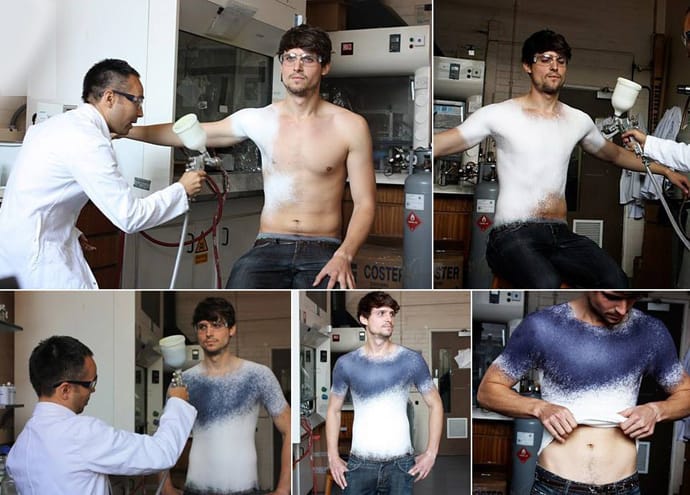
Another incredible idea was floated in the 1961 novel, Return from the Stars, by Stanislaw Lem. The novel is a about an astronaut Hal Bregg, who returns to Earth after a 127 year mission. In this novel he postulates the idea of spray on clothes the following excerpt from the book explains the idea.
“I could see how that might appeal to women, because by discharging from a few or a few dozen bottles a liquid that immediately set into fabrics with textures smooth or rough—velvet, fur, or pliable metal—they could have a new creation every time, each for one occasion only”.
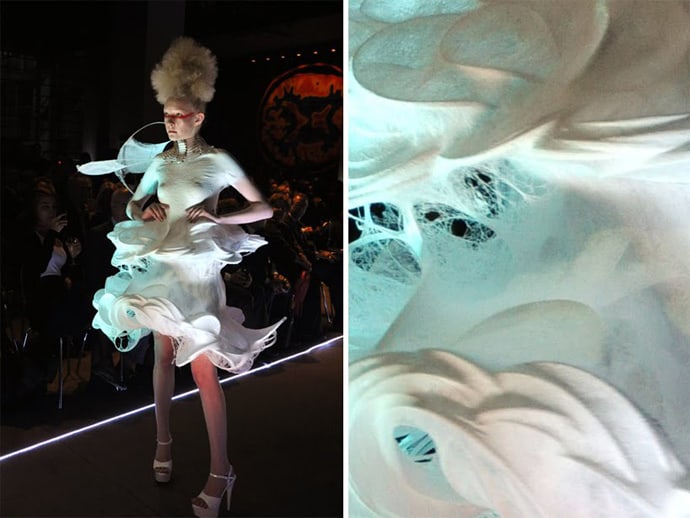
The 21st century saw this fabulous concept become real with Spanish fashion designer Dr Manel Torres’s efforts. He worked with particle engineer Paul Luckham from Imperial College London to produce a fabric that comes out of a can. Manel got the idea when he was at a friend’s wedding and the party spray foam was used as a part of the merrymaking. He went on to developing the product which claims to have myriad applications in fashion, medicine, interiors and environmental issues.


Credits:

Wednesday, February 18, 2015
costume

Thought behind the thought:
I was at a programme the other day at a school function. It was a formal prize distribution ceremony, followed by a small entertainment programme for parents. There was an act performed by the little ones that talked about the cultural heritage of India. Little kids wearing clothes belonging to different states and religions of India walked on the stage one by one. The first thought that came to my mind was that dress, gives away so much information about us in just a glimpse. It’s an unspoken communication about where we hail from what our culture is about and so much more. It instantly assigns an identity and individuality to the person donning it.
About the art:
India is a very diverse land. You move from one state to another state and chances are that the local language, food customs, and traditions will hugely differ.This rich cultural diversity makes India an indulgence that is to be savoured. All sensory organs are involved if one has to truly absorb India and its culture. India has a number of tribes and they are strikingly different from one another. Normally the first thing that’s distinctive about tribes is their costume. It not only announces where the tribes hail from but also talks about their individualistic creative sensibilities. Beautiful colours, jewellery, and hairdos make these tribal costumes a visual treat. Along with tribal costumes there are innumerable costumes used in dance and theatre in India. Let us limit ourselves today and take a look at some of the most striking tribal and regional costumes.


Ladakhi costume with heirloom headdress called Perak . The colours ,textures and materials in the costume are outstanding. The headdress is very important and becomes a focal point, adorned with flowers if brings life to the costume. Colour is used to give accents to the costume not overpower it.


Rignai and Risa are the traditional costume of the tripura women. The pattern of the "rignai"are so distinct that the clan of a Tripuri woman can be identified by the pattern of the rignai she wears.

The marvelous bead work in the costumes of the Bonda tribe from the hilly regions of Malkangiri, Odisha bring so much vibrancy to the tribe. The lightness, delicacy and detail makes this costume stand apart.Colour plays a very dominating role here as well.

The Rabaris' from northwest India are well known for their exquisite embroidery work. The way the costume is accessorized also make it distinct and bold. Probably because the colour pallet is so vivid, the accessories are muted in colour but bold in design.


Dimasa and Bodo are one of the many tribal groups of Assam. Dimasa and Bodo girls wear their traditional attire during festivals. The delicate aesthetic sensibility and ability to use bold colors deftly, are the two strong points for designers of this costume. Use of pattern, contrast and colour make this costume truly remarkable. Interestingly like most other costumes in India, these are woven, designed and made by the women themselves and artistic temper is an intrinsic ability present among most women.

Tribals' are self taught artists and probably their only guide and teacher is nature , which is abound with inspiration.The headdress is again a focal point of this costume probably inspired from the peacocks of the forest. The Baigas in the costume above are very colourful and are primarily found in Mandla and Balaghat districts of Madhya Pradesh.

The Jaintia or Pnar is a tribe from the Jaintia hills of Meghalaya. Not all tribes in India are about color and vibrancy and opulence. The costume above makes a very minimalist statement. Muted colors offset bright accents. There is an interplay between beautiful patterns and and textures to produce an almost contemporary style statement.

The aesthetic sensibility of the Nagas of Nagaland is extremely refined. A single bold color becomes a canvas, on which beautifully crafted jewellery and accessories, are displayed. The little trinkets and ornaments are so well crafted and compliment the costume so effectively that together it is a style statement in itself.


The Limbu tribe of Nepal and the Garo and Khasi tribe of Meghalaya all boast of a refined sense of accessorizing a costume. The fine understanding of color , its use and its attributes are seen in them. The tribals are possibly way ahead of us in terms of artistic understanding. Probably because they know something that cannot be taught in an art school. The all important thing they know, is to respond to one's intuitive creativity, be individualistic , be bold and be true to who you are as a person.
Credits:
Subscribe to:
Posts (Atom)